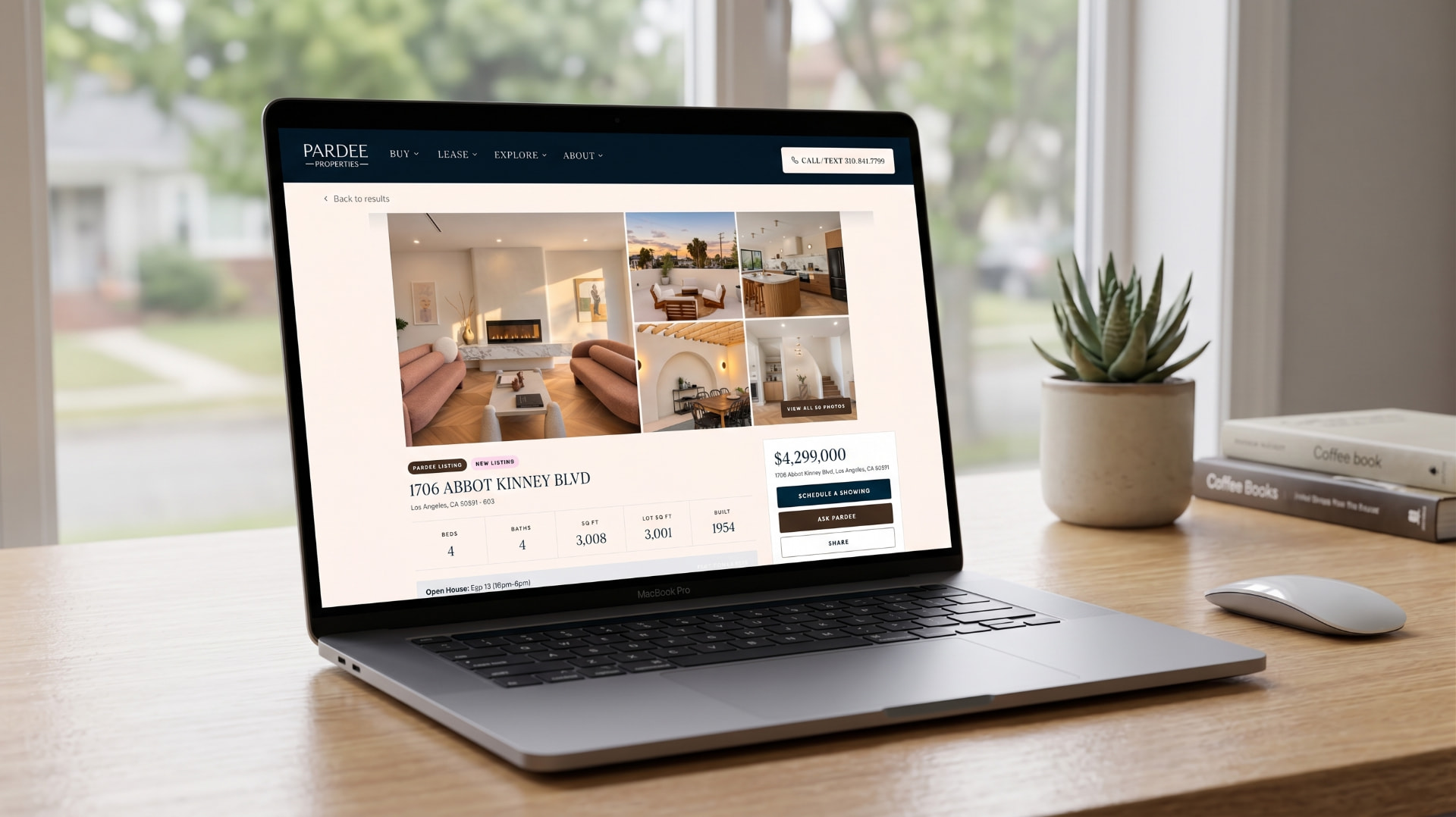
Five years of evolving a website into a marketing platform
From a 2021 rebrand and relaunch to years of iteration, new requirements and a full 2026 redesign.
Ivy’s roleBrand direction · Experience strategy · Information architecture · Content structure
A website treated as an evolving product, not a one-time launch.
What began as a rebrand-driven website redesign in 2021 became an ongoing digital product responsibility.
As the business changed, the website changed with it: new listing rules, agent needs, lead-generation programs, forms, integrations, accessibility requirements, privacy considerations, search behavior, marketing operations and emerging technical capabilities.
The work became less about maintaining a website and more about continuously shaping the experience around the needs of the business, the agents and the people using it.
350+documented website tasks + subtasks
5 yearsof continuous iteration
What five years of stewardship actually included
01
Property + search experience
Listing visibility, sold vs. active behavior, lease rules, property types, pricing accuracy, open-house expiration and search logic.
Examples
Suppress or hide listings when needed
Keep sold lease listings from displaying publicly
Define showing-request behavior for lower-priced leases
Support more property types in featured listing pulls
Show sold price rather than original list price
Keep old open houses from persisting after a sale
Refine property-page labels such as ‘Quick Facts’
02
Agent + team experience
Profiles, active listings, sales history, reviews, social links, contact information and team relationships.
Examples
Support active listings and sold history
Surface Zillow reviews and testimonials
Support configurable contact details
Preserve agent titles in email templates
Identify the intended agent in showing-request notifications
Handle multi-agent and team-logic edge cases
03
Lead + marketing operations
Forms, routing, mobile confirmations, duplicate prevention, email functionality, embeds and recurring marketing workflows.
Examples
Correctly require form fields
Prevent duplicate showing forms
Make mobile confirmations work
Use embed-capable Gravity Forms where appropriate
Preserve logging and spam protection
Support newsletter duplicate detection
Support web-based newsletter versions
Support direct links to showing-request forms
04
Accessibility + privacy
Accessibility reviews, consent, privacy, tracking and responsible implementation.
Examples
Maintain accessibility as an ongoing workstream
Maintain an accessibility-header plan
Implement cookie opt-out and Do Not Track behavior
Make tracking changes explicit
Keep privacy and disclaimer content current
05
Platform operations
Platform health, integrations, technical requirements and ongoing coordination.
Examples
PHP
MySQL
Beaver Builder
Yoast
WordPress two-factor authentication
Caching
Hosting and right-sizing
Technical dependencies across the site
06
Future capability
AI-assisted search, AEO, automation, portals and embedded marketing tools.
Explored or considered. Not all were launched.
Examples
AI-assisted search
AEO
LLM use
Custom GPT and Mailchimp automation
Blog-draft factory concepts
Intranet and client system concepts
Off-market portal and gated access concepts
Embedded vibe-coded tools where durable and on-brand
Then the brand changed again.
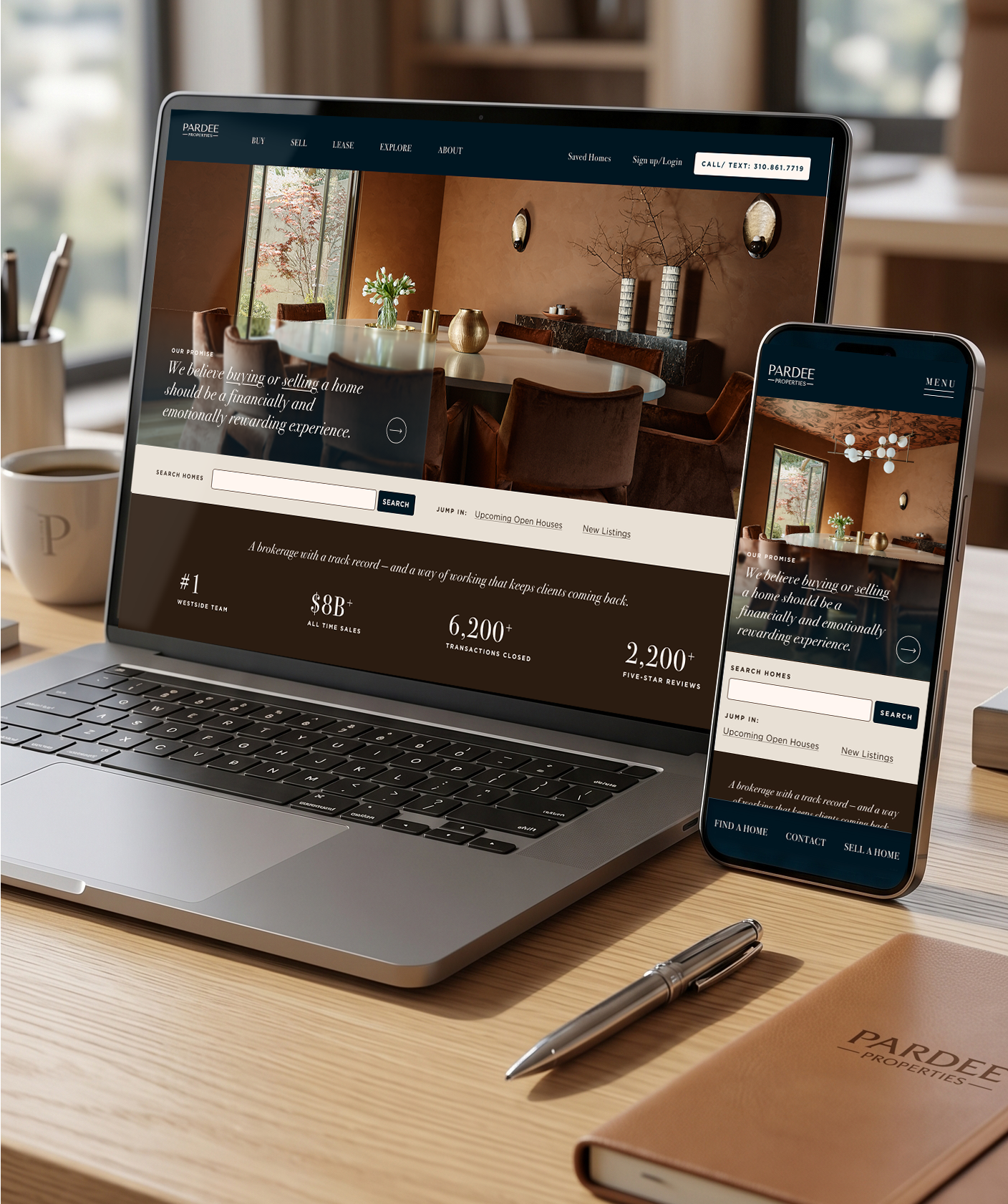
In 2026, Pardee began another full redesign tied to the company’s next brand evolution.
This time the work was not starting from zero. Years of operating the existing platform created a clearer understanding of where users struggled, what agents needed, which systems had become cumbersome and where the experience could be simplified.
Current 2026 redesign
52+documented strategic + product decisions in the current redesign alone
The current redesign spans 7 connected decision areas.
A few of the choices shaping the current experience.
01
Clarify distinct user journeys instead of forcing everyone through the same path
02
Design information architecture around intent, not internal organization
03
Prioritize the most useful information first, especially on mobile
04
Use some free useful tools to build trust, gate others for lead capture
05
Build a content system that can scale without becoming cluttered
06
Make accessibility, routing and data integrity part of the product, not cleanup work
07
Design for long-term flexibility rather than one-off fixes
From requirements to experience
My role
Brand direction, UX and experience strategy, information architecture, content structure, requirements definition, creative review and cross-functional coordination with technical partners.
My involvement included shaping requirements, identifying issues, making and reviewing decisions, refining the experience and coordinating implementation as work moved between Marketing and technical partners.
2021rebrand + website relaunch
2022–2025operate + iterate
2026new rebrand + full redesign
350+documented strategic decisions
Launch it. Run it. Learn from it. Rebuild it when the business changes.
The work began with Pardee’s 2021 rebrand and website relaunch, then continued through years of new listing rules, agent needs, forms, integrations, accessibility, privacy, search, automation and marketing requirements.
In 2026, that accumulated knowledge became the foundation for a full redesign tied to the brand’s next evolution.
The website was never a finished artifact. It became an operating marketing system.